Sunday, June 08, 2008


Cumberland House

The route from Carlton House to Cumberland House is so well known from the descriptions of the Arctic voyageurs [of the Hudson’s Bay Company] that anything from my pen is unnecessary [Well thanks Dave, that’s not much use to your readers in 2008!]

The journey admits of little variety; low, thick marshy woods of Pinus banksiana, Betula, Populus and Salix. Very unsteady rainy weather with high winds. Arrived at Cumberland House at 5pm on Saturday 9th June, [1827] and was kindly welcomed.

Here I was greeted by Dr Richardson, safe from his second hazardous journey from the shores of the Polar Sea. Every man must feel for the hardship and difficulties which he endured and overcame. What must be most gratifying is extricating themselves from the fearful Esquimaux without coming to violence. Informed him of my intention of going to Red River and sailing from Hudson’s bay; approved of it much.

Postscript – Douglas is clearly determined to get to the Red River Settlement, which I am fairly sure is present-day Winnipeg. Any confirmations from readers? Is anyone reading this?? No-one is commenting. Is anyone out there? Have the fearful Esquimaux got you all, or the terrible Stone Indians, or are you just bored with 1827?
Dastardly Deeds

I have learned with regret [writes David Douglas, 4th June, 1827] that my anticipated journey overland to the Swan and Red Rivers could not be accomplished. In the first place two horses would be requisite, to carry my papers, blanket and food – unsafe to have one in the event of dying [the horse, presumably]; in the next place, it was uncertain in what direction the Stone Indians were, and in the event of their meeting me, mine would beyond any doubt be a done career.

One of the Canadian servants was four weeks ago murdered within four miles of Carlton House, his gun and horse taken and his body left stripped. The villain who committed this horrid deed had been kept during the winter in food, being an object of pity and his family starving; in spring he manifested his ingratitude by perpetrating the foulest of crimes.

Therefore I abandoned my plan and proceed towards Norway House where an opportunity may offer of going to Red River [present day Winnipeg?]. For now I go to Cumberland House.

Saturday, June 07, 2008

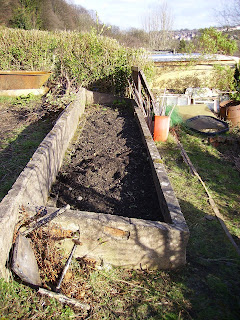
I'm sure there's an onion patch in there somewhere


There is now

Monday, June 02, 2008


Buffalo Problem, no-one dead (quite)

June 1st 1827, east of Edmonton

A party of hunters went out at daybreak after the herd of animals seen last night. Most willingly I followed them. Mr Harriott & Mr Ermatinger and three hunters went off to the opposite side of the herd and killed two very large and fine animals. Seeing their boat at the side of the river and no-one in it gave us to know they had gone for the meat and we put to shore.

Mr H & E were pursuing a bull which had been wounded. The animal, which had suffered less injury than expected, turned and gave chase to Mr McDonald and overtook him. Seeing that it was impossible to escape he had presence of mind to throw himself on his belly flat on the ground, but this did not save him.

He received the 1st stroke on the back of the right thigh and pitched in the air several yards. The wound was a dreadful laceration literally laying open the back of the thigh to the bone; received five more blows at each of which he went senseless. Perceiving the beast preparing to strike hi m a seventh, he laid hold of his wig [the buffalo’s hump] and hung on; man and bull sank down the same instant.

His companions had the melancholy sensation of standing g to witness their companion mangled and could give no assistance. His life could not be expected.

But a shot went off by accident without doing any injury to anyone, and had the unexpected good fortune to raise the bull, first sniffing his victim, turning him gently over, and walking off.

I went up to him and found life still apparent, but quite senseless. He had sustained most injury from a blow on the left side, and had it not been for a strong double sealskin shot-pouch, with ball, shot, wadding etc unquestionably would have been deprived of life, being opposite the heart.

The horn went through the pouch, coat, vest, flannel and cotton shirts, and bruised the skin and broke two ribs. He was bruised all over, but no part materially cut except the thigh & left wrist dislocated.

My lancet being always in my pocket like a watch, I had him bled [which he was doubtless much in need of, not] and his wounds bound up, when he was carried to the boat; gave 25 drops of laudanum and procured sleep. In hope of finding Dr Richardson no time was lost to convey him to Carlton House.

[Postscript – the man survived; presumably so did the buffalo.]

Sunday, June 01, 2008

Can’t dance, must jump

Last night (31st May 1827, Fort Edmonton, Canada), before we should part with our new friends, Mr Ermatinger [Edward Ermatinger, Douglas’s companion on this journey] was called on to indulge us with a tune on the violin, to which he readily complied. No time was lost in forming a dance; and as I was given to understand it was principally on my account, I could not do less than endeavour to please by jumping, for dance I could not.

Fort Edmonton was established on the Northern Saskatchewan River in 1795 by the HUDSON'S BAY CO as a fortified trading post next to the rival NORTH WEST CO, which had earlier built its own fort nearby. After the amalgamation of the 2 companies in 1821, Fort Edmonton emerged as the leading centre of the Saskatchewan district fur trade.


The evening passed away pleasantly enough; breakfasted at 5 o’clock and embarked in the boat with all my baggage and went rapidly before the stream. Put ashore in the dusk to cook supper, and as the Stone Indians had manifested hostile intentions it was deemed unsafe to sleep at a camp where fire was. We therefore had the boats tied two and two together and drifted all night.
Finding this mode of travelling very irksome, never on shore except a short time cooking breakfast, always dusk before a second meal, I began to think this sort of travelling ill adapted for botanising.

Just in the dusk had a fine chase after two Red deer swimming in the water; both were killed. Saw a huge grisly [sic] bear and a number of small plain wolves. Passed Fort Vermilion, an abandoned establishment.

On Wednesday at sunrise five large buffalo bulls were seen sanding on a sandbank of the river. Mr Harriott debarked and killed two, and wounded two more. Fifty miles further down [the Saskatchewan River] a herd was seen, and plans laid for hunting in the morning.
Here comes the rain again

It's looking uncomfortably like a repeat of last year. Everything is lank and wet. The flowering mallow (Lavatera) at the top of the plot has fallen over, because the ground it's in is so wet, and the damn pigeons are eating the peas. Pah!

Friday, May 30, 2008


Mr Douglas’s eagle

A fine young Calumet Eagle, two years old, sex unknown, I have acquired, brought from the Cootanie lands in the bosom of the Rocky Mntns, near the headwaters of the Saskatchewan River. His plumage is much destroyed.

Many strange stories are told of this bird [aka Golden Eagle] as to strength & ferocity, such as carrying off young deer entire. By most of the tribes the tail feathers are highly prized for adorning their war caps and other garments.

Are caught as follows: A deep pit is dug in the ground, covered over with small sticks, straw, grass and a thin covering of earth, in which the hunter take his seat; a large piece of flesh is placed above, having a string tied to it, the other end held in the hand of the person below.

The bird, on eyeing the prey, instantly descends and while his talons are fastened in the flesh the hunter pulls bird and flesh into the pit. Scarcely an instance is known of failing in the hunt [and this has unfortunate resonance with how Douglas himself would die in Hawaii in 1834]

This one having been taken only a few days after hatching is now docile [But] the boys who have been in the habit of teasing him for some past having ruffled his temper, I took and caged him with some difficulty [Not so docile, huh?]

Monday, May 26, 2008

Filling Up!!

The plot is filling up. Today the Courgette plantation went in ( a mere 12; if they all come good, ratatouille will be big this summer).

And the 'salad/herb' plot at the top in full sun is now full, with Sweet Peas, Cornflowers (yes, I know they ain't salads but that's where they've gone), lettuce (green salad bowl, poor, neglected too long), basil (very poor, xplanted well but no roots in the pot so they won't thrive and replacements have already been sown. And the rest of the tomatoes.

If the replacement cucumbers and the supplementary climbing french (ascenseurs francais?) come good, and the beetroot, rainbow chard & spinach need somewhere to grow (well they will; they ain't gonna mooch around moodily on the path are they?!), I can see that one of the fallow sub-plots is going to have to come back into circulation.

And don't forget the Leeks. They're ready, they're waiting. They had a small setback when I inadvertently strimmed the tops off them (neat huh? Decapitation as a small setback!) but they've recovered well and are ready to go go go.

Thank goodness Wilma Wilbury is looking after the garden at home, and here it is.

Sunday, May 25, 2008

Things I am having to re-sow

Basil - because it's all gorn orf. It's very odd. It germinated well, grew well, transplanted well but then it's gone all pale and limp and clearly won't survive. Being Neopolitan Basil, I suspect it doesn't really like northern latitudes and has caught a cold.

Climbing French Beans - nothing wrong with them, just that I need some more to fill a few gaps (cos not enough germinated).

Lettuce - nothing wrong with them either, just that I'm trying to be better at successional sowing to avoid boom or bust in the Lettuce department

Cucumber - soddy buggery cucumbers. germinated well, grew well, then died. Think they've taken Umbrage (a well-known disease of plants, caused by proximity to Lovage. TEST - what is the common German name for Lovage? Let's see if you've been paying attention)

Nasturtiums - sowed 30; germinated 1. I think they took offence; I only had a very short stub of a label, which wouldn't accommodate Nasturtium but would just squeeze in Nasty. They clearly thought I was being rude to them.
Fatigued so much.....

..... with yesterday's walking that no sleep could be had; rose at daybreak [May 22nd, 1827] and had my box [of collected seeds] opened. Found the seeds in much better order than could be expected.

Seeds or plants should be enclosed in soldered tin-boxes to prevent wet or moisture and placed in strong wooden boxes. Fortunately my shirts were in the box, so they absorbed the moisture. However from my very small stock [of shirts] being entirely rotten I can at the moment ill spare them

Saturday, May 24, 2008

Buttercups
Don't you just love them? On an allotment, definitely not but you have to admire them as a really successful plant. Tenacious, adaptable, vigorous, ineradicable, and with lovely yellow flowers too. What more could you want?

I spent two hours this afternoon digging the little beggars out of one of the sub-plots, with the results you see.

But effort is it's own reward because that part of the plot now holds twenty-ish cabbages. I'm trying something new to deter pigeons - it's some reflective holographic tape which flashes and twists and [supposedly] scares them off. We'll see. I suspect they are, at this very moment sitting next to it, hooting with derision before gorging themselves on MY cabbages.

The only good pigeon is roasted and on my plate. I have actually eaten pigeon. It was OK but I couldn't eat enough of them to make a dent in the population!
At daylight, four a.m. …………..

…… [21st May, 1827] started on foot accompanied by an old Nipissing Indian who had spent many years west of the Rocky Mountains. Although to appearance upward of seventy years of age I found him a most excellent walker. Passed a deep muddy swamp a mile broad and entered a thick point of pine of five more, when I was informed the laborious part of the journey was over.

Continued my route along Lake Bowland where two men had been sent on to fish. Having been unsuccessful and no breakfast my stay was short.

Passed the small deep rivulets by means of throwing down two trees. All the hollow parts of the plains overflowed with water – to all appearance shallow lakes. Appears to have at one time abounded in Red and Long-tailed deer, many horns being strewed over the ground.

At three o’clock came to Sturgeon River, a small deep muddy stream but at this season large, the banks overflowed. My hatchet being small, two hours were spent making a raft. I would not have lost three minutes in crossing [says intrepid Douglas], but my poor old guide was afraid the chilliness of the water would injure him, having perspired much, and on his account I assisted him in raft making.

Being then only nine miles from Fort Edmonton on the Saskatchewan my spirits revived and I hastily tripped over the ground and passed many muddy creeks, wading to the middle. Night creeping in on me, my view of the country gradually disappeared. At eight I heard the evening howl of the sledge dogs, which to me was sweet music, and perceived fires in some lodges which I knew to be near the establishment [Fort Edmonton].

Being all over with mud, I returned half a mile to a small lake, stripped and plunged myself in and then comforted myself with a clean shirt.

I was most kindly received, and had supper prepared for me of fine moose-deer steaks, which were most acceptable after a walk of forty-three miles through a most wretched country without having anything to eat.

[Now let’s just reprise that. He has risen at 4, with no breakfast, walked 43 miles with no food, wading through swamps to the middle, building rafts for his old Indian guide, and still has time to scrub-up and comfort himself with a clean shirt before supper. Fit as a butcher’s dog!]

Thursday, May 22, 2008

Tomatoes in!!!

26 tomato plants in tonight, just ahead of the predicted rain. They're a mix of Tamina (a potato-leave variety), Gardener's Delight and some Beefsteak variety. Unfortunately, mix is the right word because the labels have gone astray so, apart from Tamina whch I can recognise from the leaves, I know not what they are. Hey Ho

Now there's only the small matter of the remaining 14 to squeeze in somewhere!

Grape vine is coming on too. Just visible, altho sadly not to a camera, are the flower buds which will become grape buds which will become...... Chateau Brincliffe?
A sufficiency of fish……

….being caught for a part of the journey, raised camp at ten [May 20th, 1827], keeping a south course. Road very bad [heading SE towards Edmonton], much worse than any yet gone over; passing the numerous swamps often sinking nearly to the middle in mud and water. Some of the horses obliged us to camp earlier than expectation, being broken down with fatigue and paving to pass a thick wood five miles long where no fodder could be had.

The distance to the establishment being only (!) about forty miles I intend to start on foot in order that a few more days may be had to collect [seeds]; at the same time I am most anxious to learn the fate of my packet of seeds [entrusted to another before departure]. This day’s march is nine miles.

Tuesday, May 20, 2008

Three large rafts being made.....

....sufficient to carry all the baggage and persons in one trip, the [Pembina] river being too broad and rapid to return with one, we all crossed. Went before the brigade in quest of birds, but still unfortunate. path a little better than the preceding days, ground high and not so thickly wooded.

Shortly after two o'clock [May 18th, 1827, north-west of Edmonton] arrived at Eagle Lake in which are caught grey sucker, white fish, and pike or jackfish, where we must stay to procure wherewithal to complete the remainder of our journey to the Saskatchewan. Thirty one were caught before dusk.

May 19th, 1827

The fishermen during last night caught only sixty fish, all good eating

Monday, May 19, 2008

Back to the plot!

I've got the whole week off so this is a good opportunity to catch up on allotment work.

First job - connect the hose, empty the bottom bath of winter sludge and refill with lovely cold clean water. I love that first refill of the new season.

While that is filling, a massive weed of "Tomato Plot", then a massive weed of "Bean Plot", accompanied all the while by a robin who ate so much it's a wonder he can still fly.

I remembered the camping stove this time so plenty of tea before putting up the bean canes. This really feels like progress, even more so as the beans are sitting patiently at home, ready to go in.

Sunday, May 18, 2008

May 17th, 1827

Morning raw and unpleasant. Two hours walk through an excessively bad road took us to Paddle River, a rapid muddy creek, thirty yards wide and at present swollen over its banks from melting of the snow. A raft was constructed and two men swam across and pulled it over by a rope; by this tedious operation we all got over in the space of three hours.

This place affording no fodder for the horses, went on until we came to a low plain at midday. As soon as refreshed in the afternoon, continued through a thick woody country intersected by narrow lakes until we reached the Pembina River at dusk, and regretted at not finding the canoes which we parted from six days ago.

Saturday, May 17, 2008

May 16th, 1827

Continued our route through the same sort of country as yesterday, still bad road and nothing in the way of plants. Breakfasted in a low wet plain near a narrow lake, where we made a stay of a few hours to refresh the horses. Passed through a low point near a creek bank, in many places by old beaver dams. Entered a second plain and camped in the wood at the south end. rainy with thunder.

[Douglas is at this point in present-day Alberta, heading roughly south-east from Fort Assiniboine towards Edmonton, still some days off. The small town of Camp Creek is a good estimate of where he was. Tomorrow he'll reach the Pembina River]

Thursday, May 15, 2008

This uninteresting wretched country.......

.......affording me no plants, I took a gun and went in quest of partridges [very fond of his partridges, Mr D, especially roasted in front of an open fire, or boiled]. Killed three but only one was worth skinning. Camped at "Two Rivers" much fatigued. Observed two species of Ribes, both common west of the mountains on the margin of mountain rivulets. Showery, with hailstones of large size

David Douglas, botanist, May 15th, 1827

Wednesday, May 14, 2008

Western Canada, 1827

"May 14th. Morning dull & cloudy. At two o'clock crossed the [Athabasca] river. Took our course in a south direction through a low marshy country. path very bad, sinking to the knees in mud and kept by the still frozen soil at the bottom from going further. Killed a female partridge. Could not preserve it. Regret it"

David Douglas, botanist

Tuesday, May 13, 2008

Parallel lives

Long-standing readers of this blog (sit down, take the weight off your feet) will recall my interest (obsession?) with the life and works of David Douglas, botanist & plant collector extraordinaire, 1799-1834. I've followed him around the world, from his birthplace in Scone to where he died in Hawaii and his grave in Honolulu. If you have a flowering currant or California poppy in your garden you have a direct connection to Douglas. If you live in a house built in the UK since the late 1800s you have an even more direct connection because all your structural timbers are probably from species introduced by Douglas.

Anyway, later this summer I'm off following him again, to York Factory on the shores of Hudson's Bay. To mark this I thought I'd give you some contemporaneous accounts from his 1827 journal of his trek across the continent from the Pacific Northwest to Hudson's Bay.

Douglas has a very laconic style. Always travelling in hard, nay harsh, circumstances he makes light of his difficulties. This is a man who observes that "...so much worn out was I three times by fatigue and hunger that twice I crawled, for I could hardly walk, to a small abandoned hut. I had in my knapsack one biscuit."

Later, on the Columbia River, he observes the effect of the native's diet - "Lewis observes that when eaten in a large quantity they [Camass roots] occasion bowel complaints. This I am not aware of but assuredly they produce flatulence.; when in the Indian hut I was almost blown out by strength of wind."

He ends 1826 on the Multnomah River above present-day Portland, Oregon ending a hard-bargaining session with an Indian with the immortal words "He had my blessing and promise of a sound flogging should I ever meet him in a convenient place."

Now let's pick him up contemporaneously. Here he is on May 13th, 1827 on the Athabasca River, on his cross-continent journey with the voyageurs of the Hudson's Bay Express. He has already spent two months coming up the Columbia, over the Rockies through the Athabasca Pass and is now working his way down the Athabasca River.

"Sunday 13th. Close and cloudy. By making an early start 10 miles was gained to breakfast; shortly afterwards we left the canoe and cut over a low point of wood and arrived at Assiniboine at two o'clock. Mr Stuart killed a male partridge. I make some small slug and procure a pair of this fine bird."

Watch this space for more from David Douglas, as well as normal service from his mate Woody Wilbury at Allotment 81.

Sunday, May 11, 2008

Kew!!!!

Just look at this


It is of course the Titan Arum, fast approaching flowering. It currently stands at around 2 metres tall and will reach 3 metres before flowering. Then you need to batten down your nostrils because the smell it emits is obnoxious. And the female flowers are receptive for one night only, the night before the male flowers produce pollen. There's playing hard to get and there's being positively awkward. Hand pollination is difficult and involves two inflorescenses flowering in perfect sequence or the use of frozen pollen. Frozen pollen!! Ye Gods.

You'll deduce from this that Woody has been to Kew, where this is growing in the Princess of Wales Conservatory. Kew is fabulous, and I hadn't been since I was a teenager, umpty years ago. Why? Fool.

Outside Woody was pleased to spot Kew's Gingko biloba, dating from 1762.


This is one of the few trees remaining from the first botanic garden established by Princess Augusta, George III's mother, in 1759.
And just for North Atlantic balance, here's the oldest Gingko in North America, growing in Bartram's Garden, Philadelphia, and also dating from the late 1700s (1785 to be [fairly] precise). The tree was there when David Douglas visited Bartram (King's Botanist in N America) in 1823. Bartram himself wasn't there, having inconsiderately died 6 weeks earlier. The tree is still in good shape, or at least it was in 2001 when I was there, but if you look closely you can see steel cables holding it together. But at 250+ yrs old I think it deserves a bit of support.

Monday, May 05, 2008

Massive Attack....
..... on the weeds and general herbage, which is going forth like ye olde clappers at the moment, it being moist and waarm (a Sheffield word for 'not-quite-hot'; usually prefacing a nice pint of Waards - a Sheffield word for beer, sadly now defunct in it's home town). I work less than a hundred yaards from the former Waards brewery and lament the lack most days.

Anyway, back to the point (terrible stuff for making you wander, this Waards). Weeds seen orf today, don't y' know:

Yer garlic patch
Yer onion patch
Yer blackberry patch, and
Yer raspberroonie patch.

Only one of them proved photogenic so here's the garlic patch, newly weeded and pristine, with a quick glimpse of AlcaBrassica behind.


And here's a bluebell looking very Young At Heart, we're so Yo-ung at Heart.


Very pleased with the blackberries, which are sending out new shoots like they mean it, much ahead of where they were last year. Perhaps piling manure around their rootstock really does work? Perhaps they're trying to get away from it? I would if you piled manure around my rootstock.

And the raspberoonies; what about the raspberoonies, eh? Thought dead, no signs of life, nailed to perch, choir invisibule etc. But no, 19 of the 20 have rooted and are putting forth new growth. Well pleased about this because the last attempt was an unmitigated failure.

And finally, the grapevine looks as though bud break is imminent. The buds are huge and furry and look truly fecund. Fecund, I tell you, Fecund. Pictures next time.

Wednesday, April 30, 2008

Heading North, not South

I should, as I type this, be on a ferry in the middle of the North Sea, en route to Denmark to start the first leg of Short Way Round, my motorcycle trip round the edge of Europe from the very top of Denmark to Istanbul and beyond. For all you know, I may be on that ferry. But I’m not, I’m at home. Short Way Round is postponed, in favour of an equally big adventure on a different continent.

Those of you with long memories may recall me banging on about my Winston Churchill Travelling Fellowship in 2001, following in the footsteps of David Douglas (Google him), botanist and plant collector (1799-1834). This adventure is to do some unfinished business from my Fellowship and start an entirely new project.

Context first. In 1827 Douglas set off from Fort Vancouver on the Columbia River in the Pacific Northwest with the voyageurs of the Hudson’s Bay Company to travel east across the continent. Their destination was York Factory, the HBC’s eastern supply base for the fur trade in the Canadian sub-arctic, from which Douglas was to sail on an HBC ship back to England. They made it, walking and birch-bark canoeing. D caught the ship and made it safe home for further adventures before a gory end on Hawaii in 1834 (I’ve stood where he died and at his grave in Honolulu).

York Factory is still there (Google it) and almost as hard to access now as in 1827. There’s no road or rail link; there’s no electricity and no food, apart from what you bring in. But I’m going there in the summer, with two colleagues (one from Scotland and one from Oregon) to start filming a television documentary on Douglas.

None of us have been to York Factory before; indeed it only gets about 70 visitors a year. Only being open for 3 months of the year, frozen tight the rest of the year and at risk of polar bear attack may have something to do with that of course! It’s only about 60 miles south of Churchill, where the bears congregate in the town waiting for the sea to freeze (it’s still frozen now).

The route runs something like, fly to Winnipeg, fly further north in a smaller plane, get a Greyhound bus for three hours on a gravel road to (literally) the end of the road. Then get an even smaller plane (5-seater, float plane I suspect) to fly to York Factory. Then do it all in reverse 3 days later.

And in due course there’ll be more filming to fill in more of the blanks of the Douglas story.

This is an opportunity which has been a long time coming and can’t be turned down. Short Way Round, on the other hand, can be done ‘later’. And it’s only postponed, not ‘off’. I’m really looking forward to this; can you guess?!!

Sunday, April 27, 2008

Fort Brassica

At last planting has got under way, with cabbages (spring, round and red) and cauliflower. We love red cabbage. Monty Don describes it as being only slightly ahead of boiled rat in culinary acceptability, at least by his children. All I can say is they've never had any of ours, cooked with red wine, apple and marmalade. Yummy.

But growing brassicas round here is an iffy business on account of they pigeons, curse 'em. I've tried various half-baked approaches with dangling CDs to scare them off but I think they treat them as vanity mirrors; certainly doesn't scare them off. And I've nearly broken my neck innumerable times getting my feet tangled up in the netting I've carefully draped over the cabbages to keep pigey off. None of it is much good.

The best I've found so far is Fort Brassica, constructed from uprights of chicken wire, lovingly garnished with tatty old netting and tenderly enrobed with string. Let's see the beggars get through that.

Running low on blood sugar by the end of the afternoon and lacking the energy to construct a smaller version for the cauliflower plot, I cobbled together Mark 2. The observant among you will notice what were once wardrobe drawers from IKEA forming a key part of the construction.

Lest you think I idle my time away just pratting about with cabbages, chicken wire and string I should show you my other pride and joy. Just look at these mangetout; sown in a gutter at home (no, it wasn't attached to the house at the time, honestly, you do take this too seriously sometimes) and raised in the conservatory. Then simply slid into a wee trenchette and Bob is your father's brother. Still need plenty of anti-pigeon fortifications though.


I've also discovered another reader, just over the grapevine at the bottom. Good to speak to you today; hope all this makes sense.

And finally, longstanding readers of this blog may be wondering about a progress report on Woody's motorcycle adventure around Europe (working title Short Way Round). Tune in on Wednesday (30th) for an update. A bientot; tot siens!!

Tuesday, April 15, 2008

Crikey

Turn your back for a moment and you never know what will happen. In this case Ivan-on-the-next-plot has had a massive burst of enthusiastic hedge trimming and the hedge between us is now down to about 3 feet or less and very thin.


Hmm

Not sure what i think of this. It'll certainly be easier to keep tidy, once it's regrown a bit, but it compromises my privacy a bit and offers no security at all.

Hmm.
I'd like to have known he was going to do it too. Didn't necessarily want to be asked, in the sense of being asked for permission, but it would have been nice to be consulted, it being a joint hedge and all. Ah well, it's done now & not worth falling out over.

What else is new? The grapevine is now tied in to three posts and two strands of wire, ready for some growth this summer.
Chris, my on-plot neighbour has been very active and threatens to put me to shame. He now seems better established, having done lots of work over the winter.

And finally, I've now joined the plot association.
I've belatedly realised that they aren't just an association for plot holders but a shop, cheap garden stuff for the selling of but only between 10.30 & 12 on Sunday mornings. Still think they could be more proactive in marketing themselves to plotholders but no matter, I've joined now. Lots of amusement from Wilma Wilbury, who sees this as a sign that I'll soon be growing chrymanthesums and wearing a cardigan. Pah.

Sunday, April 13, 2008

Really love that Lovage

Gnome asked for a feature on Lovage, after my comment about it waking up from the winter and heading for a Lovage hedge this year.
Herewith, from a combination of Wikipedia & my experience of it. Lovage (Levisticum officinale) - well, you didn't expect a former botanist not to give you the full name did you? - is dead easy to grow and once you've got it it'll take a JCB to get rid of it. But why would you want to get rid of it? It has a lovely flavour, akin to celery which it vaguely resembles, and the leaves and seeds are used to flavor food, especially in South European cuisine. It is a tall (3 to 9 ft) perennial , hence the reference to a Lovage hedge. It looks pretty impenetrable when in full flow but is quite soft really and dies back completely in the autumn so is no use at all as a 'real' hedge. Lovage also sometimes gets referred to as smallage, but anything less appropriate is hard to imagine. Mine was grown from seed last year and I confidently expect it to get to at least four feet this year. Here it is now:

Lovage is considered to be a "magic bullet" companion plant; much as borage helps protect almost all plants from pests, so lovage is thought to improve the health of almost all plants. In Germany and Holland, one of the common names of Lovage is Maggikraut (German) or Maggiplant (Dutch) because the plant's taste is reminiscent of Maggi soup seasoning. Or could this perhaps be a vice versa?? We use it a lot in Wilma Wilbury's damn fine fish stew.

Finally, Lovage tea can be applied to wounds as an antiseptic, or drunk to stimulate digestion.

There you are then; all the news that's fit to print about Lovage. I particularly liked Maggikraut; I think I met her once.

Sunday, March 30, 2008

The Oldest Spade?

How old can a spade be and still be in use?

If you kept it clean after every session and gave the shaft (assume it’s wooden) some linseed oil, say, once a year, how long would it last?

I’d have thought 100 years was quite feasible. 200? More? Would the blade wear out before the shaft?

Comments, answers and examples please.

And let’s not have any “Grandfather’s axe” answers!!

You’re not familiar with Grandfather’s axe?

“This is a really good axe. It used to be my Grandfather’s. Mind you, I had to put a new head on it last year, and it’s had a couple of new shafts too.”
Surprise, Surprise

I’ve started clearing the neglected area at the bottom of the plot, which was piled high with old rotting wood. But when I moved that some foundations began to emerge. Clearing those with the gardener’s best friend – the pickaxe - the foundations of a large greenhouse appeared.
It spans most of the width of the plot, with a central stone path and two brick-edged beds either side. I sense a restoration project coming on for the winter!

And rooted in one corner I discovered a grapevine. It’s very neglected and tangled
but it is unmistakably a grapevine. It’s a bit late for pruning so I’m just going to bang a couple of posts in, stretch wire between them, tie it in and see what happens. Perhaps give it a bit of manure to feed it too. Exciting or what?
I've also banged three Bishops in. Bishop of Llandaff dahlias, that is.

Saturday, March 29, 2008

Love that Lovage

The lovage is back after its winter sleep. I love lovage and I’ve got three plants, grown from seed last year, which will make a lovage hedge this year.

Elsewhere, it’s been “get the onions in” day. Five rows altogether, with 3 of Stuttgart Giant (150), one of Red Baron (50) and one of Shallots (just shallots!). It was lovely work as the ground was so soft from yesterday’s rain, and now it has rained again so they’ll be nicely bedded in and soaked. Just perfect for a good start.

And it’s interesting to look around at all the other allotments and reflect on how they have changed since I took this one. At that time mine was waist high grass and 4 metre high hedges. The plots left and right were derelict as were the two plots immediately downhill of mine. Now every one of them is taken and being cultivated. Some have further to go than others but all are unrecognisable from how they were four years ago. Another which was seriously derelict a few plots along from me is being slowly but surely brought back to life; it had a working party there today concreting in fence posts for a gate. Hanging a gate, and fixing the shed (which they’ve also done), are sure signs that you’re there to stay.

I’ve thought for some time that allotments are like pig farms – always boom or bust. You can turn a pig farm around very quickly because they breed quickly and have big litters, so you can start from not much and have a lot of pigs quite quickly. But that depresses the price so you then go bust. Allotments are a bit like that. Their moment comes, lots of people take them, then realise how much hard work they are and fall away again.

But at the moment allotments seem to be definitely on the up. Long may it continue.

Monday, March 24, 2008

A sower went forth to sow....

and so far he's sown:

Tomatoes (Moneymaker, Beefeater, Tamina & Gardener's Delight)


Leeks ( some leekish sort, not Musselburgh)

Chillies (Cayenne and Scotch Bonnet)
Scotch Bonnet!!!! Wow. H-O-T-T HOT
Me and My Mum and My Dad and My Gran, went to Waterloo.
Me and My Mum and My Dad and My Gran, had a bucket of Vindaloo.
And that's what we'll be doing if they Scotch Bonnets come up to promise.

Cabbage (early). V soothing after the Scotch Bunnets

Cauliflower (All Yr Round)

Basil (which will be good if it gets off its backside and germinates - I'm firmly convinced there are Basil years, in which you can't go wrong with it, and Sybil years, when no matter what you do it just won't germinate (probably terrified).

Parsley (Flat leaf)

Impatiens

And then there's the Geraniums (x2), Impatiens plants Lavender (x2), Rosemary and Sweet Peas (x2), all taking shelter from the intemperate weather.
No wonder the conservatory is begininng to look a little 'occupied'.

Sunday, March 09, 2008

Not quite the kitchen sink


But good enough to boil water for tea! And what better to do when digging is interrupted by rain. But, eventually, all the digging is finished now, with the potato plot being last. That's going to be one-third spuds, one-third courgettes and one-third cucumbers.

Saturday, March 01, 2008

Back to the plot

Enough of this motorbiking stuff, time to get back to the plot. And I have to say it's looking pretty good, especially the rhubarb.


And all around are unmistakable signs of Spring. Ivan has a new [metal] roof on his shed (now that's a good idea), Chris has cut back his hedge to a manageable height, and I've dug & manured Plot 8 (which always has tomatoes in it.


But, more important than that, I've sown my leek seeds. What better symbolism than sowing leeks on St David's Day. Just be glad it wasn't parsnips.

Friday, February 29, 2008

Try not to fall off the edge!

It's lashing with rain and no allotment work is do-able on what is a day off so I'll tell you a bit more about the biking trip. Basically it is riding round Europe. But I sometimes have a very literal mind, and this is literally riding round Europe.

Starting at the top end of Denmark, where North Sea and Baltic meet, it's following the coast (keep the sea on the right and it'll be fine) all the way round to the Galata Bridge in Istanbul, where the Black Sea and the Mediterranean symbolically meet at the Golden Horn. It goes, pace McGregor & Boorman, by the working title of Short Way Round.

Of course it's anything but short. Denmark to the top end of Italy is almost 6000 miles, then there is all the way down Italy and all the way back, then down the other side of the Adriatic. It's an awfully long way round the in and out bits of Greece, and Albania promises to be 'interesting'.

And then you ask - "so OK Woody, you've got to Istanbul; now what? How do you get home?" Ah well, you see, I keep going, round the Black Sea coast, across the Danube delta to Odessa. I've always wanted to go to Odessa and the Potemkin Steps. By now, of course, I'm in the Ukraine and it really is time to turn home. So it's a sharp left from Odessa into Moldova, through Chisinau, back into the Ukraine and Lvov, over the border to Poland, call on our friends in Lezajsk (damn fine brewery in Lezajsk) and back to the North Sea coast, having gone all the way round.

"Hell's teeth, Woody", I hear you say; "you must have chuffing good holiday entitlement." Well, not exactly, and in truth it's going to take several stages and several years to finish this. I reckon I'll be around 63 when I finish it (almost 58 now).But if you don't start you never finish and I'm a great believer that "A journey of 1000 miles begins with a single step". I remember, aged about 12 and living in a council house in Co Durham, realising that I could get to anywhere, literally anywhere, by walking down the garden path and keeping going. That's never left me.

More details, preparation etc in due course. You'll want to know how Wilma Wibury fits in this too I guess. But, for the moment, allotment service will resume shortly!

Saturday, February 23, 2008

Get your motor running

Later this year I'm off on a biking trip in Europe, on this fine fellow.


More details in due course but it will start at the very northern tip of Denmark, Grenen, where the waters of the Baltic meet those of the North Sea. Strictly it's where the Kattegat meets the Skagerrak.

And what has this to do with an allotment, do I hear you ask? Nothing whatsoever, but I've got to start somewhere!! When I get round to it I'll set up another blog to focus just on that but for now we'll leaven allottment posts with biking posts. You'll get used to it.

Wednesday, February 20, 2008

Rime Intrinsica....

...Fontmell Magna, Sturminster Newton & Melbury Bubb
Whist upon whist upon whist upon whist drive, in Institute, Legion and Social Club
Horny hands that hold the aces which this morning held the plough -
While Tranter Reuben, T. S. Eliot, H. G. Wells and Edith Sitwell
Lie in Mellstock Churchyard now.


I've always had a soft spot for Rime Intrinsica, and Betjeman generally. The above is the first verse of Dorset. What euphony!

Meanwhile, here is the trigger for it all, viz lots of Rime Intrinsica at -7 in the garden this morning

Sunday, February 17, 2008

Raspberries

I love raspberries, but my previous attempt to grow them on this allotment came to naught. I suspect I'd left them in the pot too long before planting, and then not watered them enough, so they never properly established.

So I'm trying again. 12 canes of Glen Moy and 12 of Joan J (and the Blackhearts?), which seems to be the modern replacement for Autumn Bliss. Here they are. I've given them a good soak. Fingers crossed. The Glen Moy will just grow but I should get some raspers off Joan J, being an autumn fruiter.

That's it really. More digging, finished plot 4, plots 5 & 6 are fallow under plastic sheet and I've dug the spuds out of plot 7 to act as seed pots for this year - they've already started chitting (filthy beasts). Rhubarb is coming along nicely too

Saturday, February 09, 2008

Go for the Burn

There's nothing quite like a good bonfire to get rid of a heap of old rubbish. The allotment looks quite tidy now!


And I've put in some new rhubarb (Victoria), appropariately enough next to the Victoria plum, which knows it's gotta do better this year or it too will be on a bonfire. I'd show you a picture of the rhubarb but, being underground, you can't actually see it. Doh!

So here are a few pictures of a tidy shed instead (when you can't satisfy the custmers fob 'em off with something useless!)