Wednesday, August 27, 2008

August 23rd, 1827

Thunder & lightning during the night. As usual made an early start and reached Oxford House at ten, where we took breakfast [all these places still exist. Oxford House is a small community housing the Oxford House Cree Nation]. Proceeded at eleven and passed some very bad rapids. Launched the boat at Trout Fall Portage, where the remainder of the day was spent repairing the boat [by this time they aren't in small canoes any more but in York Boats, large boats specifically developed for freight on Lake Winnipeg and the Hayes River]

Friday 24th August 1827


On leaving Trout Fall we found the boat still made water but as the wind was favourable no time was lost. Entered Lower Jack River at sundown where we camped, a small narrow stream with low banks.

Sunday August 24th, 2008 - We're Out!!!

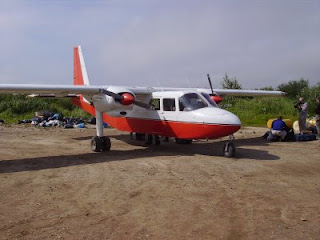
The storm finally eased after keeping us detained for two extra days. Saw two polar bears on the day we left and two bald eagles. We've finally completed our filming at York Factory; on the last day we were able to touch permafrost, which in this location is about 18" below the floor of the main building.

So, an hour on a bush plane, four tedious hours in Gillam (one of the least exciting places in this world) and a flight back to Winnipeg and we're back in the Fort Garry Hotel [located on the site of the original Red River Settlement visited by Douglas in 1827]
Aug 21st, 1827

Started a little before day. Passed through a small lake and creek until we arrived at White Fall portage at ten - a small cataract with high rocks on one side, adorned by timber. At four, left and passed the upper or small hill gate where the boat was lightened previous to running the rapid. Navigation intricate [and flying over it you can see why - it's MAMBA country, Mile After Mile of Bugger All, except for endless small lakes and streams. The country is 50% water]

Wednesday 22nd August, 1827

At seven came to Hill Gate, a rocky rapid narrow part of the river, where considerable time was lost lowering the boat with the line. Timber gradually becomes smaller as we approach the coast [indeed, thin poor soil, marshy conditions & cold climate = poor growth]. Shortly after noon entered Oxford Lake, a small narrow but beautiful sheet of water with bold rocky banks and numerous islands.

Saturday, August 23, 2008

Despatches from York Factory

Weather has turned v interesting here. It's gone from 30 deg on the day we arrived to 3 deg yesterday. And it's blowing a mighty storm. That causes problems because the airstrip for the bush plane is on a big island in the middle of the Hayes River, with a rough boat trip to it, and it's so stormy we can't get to it, and the plane isn't flying anyway. So here we still are. Weather is forecast to ease tomorrow so the plane may get in then. Plenty of food and it's warm enough, and of course a real sense of how it was in 1827! So windy last night it blew both the flag and the top of the flagpole away. And bears were seen around the building we've been filming in just 2 days before we got here. We saw one in the distance as we flew in.

Tuesday, August 19, 2008

Mon Aug 18th 2008

Not a great start to the Following David Douglas adventure. Hurt back (again) on the day before departure then, minutes before departure, found car had a flat tyre. Train to airport, long flight to Toronto (pronounced Tronno locally) and a delayed flight on to Winnipeg. Arrived Winnipeg 12.15 am (or 6.15 am body clock time). What does the song say? "Things can only get better"

August 19th, 1827

After having everything [his seed and plant collections] packed up by ten a.m. embarked in Mr Bird's boat and descended the river. Camped twenty five miles below; country low, swampy, trees small. Found nothing different from what I had seen before. In the evening at my usual work changing and drying papers.

Sunday, August 17, 2008

Norway House and Manchester Airport

1827 – Friday August 17th

Morning rainy; took breakfast at six a.m. and continued under a strong breeze till four p.m., the last point of the lake when the wind failed. Pulled [ie. rowed] over the narrow bay to Norway House, where I found Messrs John Stuart and Cameron on their way to their winter quarters. Both these gentlemen showed me every kindness and informed me that Captain Back had passed two days before for Hudson’s Bay

2008 – Sunday August 17th

Packing almost complete, but as I stepped out of the shower this morning my lower back went Twang. Consequently I am somewhat bitter and twisted and in some discomfort. Sitting on planes for many hours tomorrow is absolutely not the right thing to do for a bad back but it is nevertheless what I’ll be doing. Aww; stop milking it, Woody. This wouldn’t have stopped David Douglas. No, but then he died at 35.
--------------------------------------------------
Norway House now

Annually, in the first week of August since 1973 the Norway House Cree Nation hosts the Treaty & York Boat Days. A summer festival that relives the community's history during the time of the fur trade and the accomplishments that resulted from the "will to succeed in life." These are symbolized in the famous and living icon enshrined in the community on the banks of the Nelson River.

The celebration honors those Cree, Metis and European settlers that carved out the community during a time when survival depended on an iron will and steady determination. The World Championship York Boat Races pays homage to the strength through determination of contestants from all over Manitoba and neighboring Provinces / States, who take it upon themselves to heave and thrust fifty pound oars in an effort to claim supremacy in the races. Sweat, calluses, and aching limbs are reminders of the tremendous stamina required to propel the mighty York Boat. "The race is part of our history. In the past, you had to be in good shape to take these boats from York Factory, filled with supplies and furs, to Norway House and on to markets in the South. In those days, there were routes along the mighty Nelson River and many times rough sailing on Lake Winnipeg. Today the race is a strong reminder of how hardy our people were." Treaty & York Boat days is a rich and many-colored showcase that highlights the culture of the Norway House Cree and welcomes people from all over the world to join in the celebration.

The Norway House Cree Nation is 450 air kilometers north of Winnipeg at the intersection of the Nelson River and Playgreen Lake. Norway House consists of approximately 124,219 acres. The language of the Norway House Cree Nation is Cree and English. Based on the Norway House Cree Nation membership office, the population as of December 31, 2004 was 6,019; the band has an on-reserve population of 4,460 and an off-reserve population of 1,559.

----------------------------------------------------------------------
1827 – Saturday August 18th

Left Norway House at six a.m. in company with Mr Jos Bird, with whom I intend to complete the remainder of my journey. Passed at eight o’clock two canoes in Play Green Lake containing the men belonging to the Land Arctic Expedition on their way to Montreal. Made but little progress having a strong wind against us. At midday gained the lower establishment on Jack River. Learned with regret my Silver-Headed Eagle had died of starvation. I found every other thing safe. The roots, both dry and those hid in the wood, (on July 2nd) in good condition.

2008 – Monday August 18th

An advance post because tomorrow will be a travelling day. Next post will, with some luck, be from downtown Winnipeg. I fly out of Manchester mid-afternoon for Toronto, change planes in Toronto and stagger into Winnipeg at 10p.m. local time, which will be 4 a.m. by my body clock.

In the meantime, Wilma Wilbury will be holding things together here at Fort Wilbury. It hasn’t gone unremarked that I’ll be in Winnipeg on our wedding anniversary; our 36th wedding anniversary at that. Wilma Wilbury is very tolerant of these expeditions (thank goodness).

Rough weather and a Twinflower - Lake Winnipeg, August 1827


Wednesday 15th, August, 1827

Weather same throughout the night; still unable to proceed. Found and laid in specimens of Linnaea borealis (in fruit). This is the first time I have ever seen this plant in this state.

Linnaea borealis (aka Twinflower)
General - a creeping broadleaf evergreen shrublet, up to 10 cm tall; stems creeping or trailing, with numerous short aerial stems rising from the stolon.
Flowers - pink, with 5 petals, bell-like in pairs; very fragrant, on Y-shaped stalks. Blooms June through September over most of its range; flowers last about 7 days.
Fruit - small, dry, one-seeded capsule, maturing approximately 36 days after flowering; appearing in August and September.
Common throughout NW Ontario's boreal forests; in open shade, dry or moist sites, often associated with moss-covered surfaces
Used by Native North Americans to brew medicinal tea.


Employed all the forepart of the day drying papers and shifting plants; no place that I can walk, being all swamp.

More moderate at noon; started and gained seven miles at three, when the wind sprang up from the same quarter, which obliged us to put to shore on a sandy beach exposed to the weather. Afternoon & evening the same.

Thursday 16th

Weather stormy until eleven a.m. when the boat was launched and pulled off. Called at Banning’s River where we made a stay of a few minutes. Learned that the other boat from Red River had passed the preceding night.

On leaving this place at four p.m. a favourable breeze sprang up and, being anxious to lose no time, did not put ashore to sup but went on along the shore under easy sail until daylight.

Saturday, August 16, 2008

Struggling up Lake Winnipeg, August 1827

New readers start here:

David Douglas, botanist and plant collector extraordinaire is currently (in 1827) making his way across North America from the Pacific coast in the company of the voyageurs of the Hudson's Bay company. He has been travelling since mid-March when he left Fort Vancouver on the Columbia River. After a spell in Fort Garry (now Winnipeg) he is heading up Lake Winnipeg on the final stage of his journey to York Factory, the Hudson's Bay Company depot on the western shore of Hudson's Bay, where he will take a Company ship back to England.

Next Monday I fly out to Winnipeg to start retracing his steps for this part of his journey. We start filming next Wednesday at York Factory (try Google) for a TV documentary on Douglas. More reports in real-ish time as we go along.

Sunday 12th August, 1827

Last night the wind increased to a perfect hurricane and the water rose so high as to overflow our camp [Lake Winnipeg is well known for these wind-induced surges], so we had to betake ourselves to the boat for the night. Wind more moderate at sunrise; started at 9 o’clock, sea nearly calm. Nothing occurred.

Monday 13th

The wind at two a.m. being favourable and moonlight, we started under easy sail until daybreak. Morning cloudy and heavy, rain from six to eight. Put ashore to breakfast. The weather being somewhat drier, proceeded at nine and crossed over to the south side of the lake, when the wind veered round to the south-west, which prevented us from going. Put ashore, camped and remained four hours, when it calmed; proceeded a second time although the weather was still gloomy. Nothing occurred

Tuesday 14th

Morning dull, cloudy and drizzly; rain at eight. Started with a favourable breeze at five o’clock and gained the “Dog’s Head” to breakfast at half-past eleven [late breakfast then!!] Passed “Rabbit” point at one and a second at four, when the wind shifting to the west we were obliged to run back to a small sandy beach and run the boat on the shore. Ere all the baggage was out, the waves were breaking on the shore with all the violence of a sea hurricane. In the course of the evening the boat had to be hauled up as the surge rose on the shore, all our strength being inadequate to pull it up at once. Blowing with increased violence. Now ten o’clock.

Monday, August 11, 2008

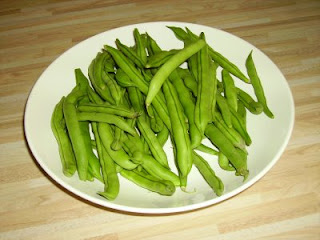
BEANZ MEANZ........


.....these little beauties. Climbing French. Aren't they lovely?
Moving on at last

Friday 11th August 1827

[After many days at the Red River settlement David Douglas is ready to move on, heading north towards Hudson's Bay and his ship back to England.]

Lest the boats be delayed in transit by bad weather on the lake too long to meet the ship in Hudson’s Bay, I thought it prudent to make my stay no longer. To Mr D McKenzie (Governor of the Colony) I am greatly indebted for his polite attentions. After bidding him and the Bishop adieu, I left the establishment in company with Mr Hamlyn, the surgeon, for Hudson’s Bay

Had some cheeses presented me, which I could not well refuse. Camped a few miles below the rapid.

Saturday 11th

At five proceeded down the river with a light air of wind and entered the lake [Lake Winnipeg] at eight o’clock. Continued our voyage along the southwest side of the lake for 15 miles when we came to a small narrow sandy island and put ashore to boil the tea kettle [Douglas is notorious for his love of tea – “The Monarch of All Foods”].

Continued our route prosperously until three o’clock when the wind became contrary. It became suddenly boisterous and much hard labour before we got to shore. The oars were long and by the heavy swell it was nothing but plunging. Landed on a low thinly wooded island at half past five; our poor men exhausted and myself somewhat anxious. From the appearance of this and many others in this lake the water has risen to a considerable degree. Trees are buried to the depth of eight to ten feet and many places are seen with dead poplars standing erect that no doubt were woody islands.

Sunday, August 03, 2008

But soon recovers

Wed, August 1st, 1827

At daylight started on horseback to a small low hill about sixteen or eighteen miles east of the colony, composed of limestone rock with a few low poplars, will and birch in the low places.

The plains being overflowed for or five miles back from Red River, had to go round by Sturgeon Creek on the Assiniboine River. Returned late at night [having made 17 additions to his botanical gleanings]
Mr Douglas is ill

Having spent all the intervening days cataloguing and attending to his collection, David Douglas is having a couple of off days.

Sunday July 29th, 1827

Very hot and sultry; thunder in the evening

Monday & Tuesday 30th & 31st

Much indisposed; violent headache and feverish. Had some medicine of Mr Richard Julian Hamlyn, the Company and Colony surgeon, who has been attentive to me. Unable to go out
Hacking through

Although some bits are still distinctly jungloid I take comfort from the fact that after three hours intensive effort (which according to the Times Health Club comfortably disposed of 1300 calories) I can now see the beans and leeks
and can get up and down the path without a machete.


I've also managed a good picking of blackberries from what is now a sturdy blackberry 'fence'. I also take comfort from the fact that everyone else seems to be in pretty much the same boat, and some are worse!!! Can't afford to take your eye off the ball for a moment at this time of year.

Saturday, August 02, 2008

A man considerably above six feet and proportionally stout

Saturday 14th July, 1827

Monseigneur J N Provenchier, the Bishop of the Roman Catholic Mission, called on me and made a long stay.
The bishop speaks good English but with that broken accent peculiar to foreigners. His companion [Rev Theophilis Harper] speaks English with as much fluency as his native French.

They conversed in the most unreserved affable manner and made many enquiries concerning the different countries I had visited. I have some reason to think well of their visit, being the first ever paid to any individual except the offers of the Hudson’s Bay Company.

I am much delighted with the meek, dignified appearance of the Bishop, a man considerably above six feet and proportionally stout; appears to be a man of the most profound acquirements, seen only through the thick rut of his great modesty.

The Winnipeg Time Machine tells us that "Provencher was head of the Catholic Church in western Canada but Bishop Provencher slept on a block of oak as his pillow to show his self denial. Standing a majestic 6' 4", in his long flowing robes, Provencher was described as a most handsome man of about 300 pounds. Norbert Provencher looked larger than life. Provencher's mission was to convert the Indian nations and to "morally improve" the delinquent Christians who had "adopted the ways of the Indians. Abuse of alcohol was rampant and Provencher tried to discourage the HBC's sale of liquor and beer to natives. He also railed against the conjugal lives of the settlers who took on "wives of convenience."

He is commemorated today in Winnipeg by Provencher Bridge, immediately north of Fort Garry, and Boulevard Provencher.

Sunday 5th July

At church. There being no timepiece for the colony and the habitations widespread, the hour of the day is guessed by the sun. The service being begun half an hour before I got forward, in consequence of missing the proper path, the clergyman seeing me from one of the windows, despatched a boy to fetch me on the proper path. This struck me as the man of the world who, in the parable, was compelled to go to the feast by person stationed on the wayside.

Wednesday, July 30, 2008


Thursday 12th July, 1827 - Fort Garry at last

Morning cool with a heavy dew. Started at 3 AM up the river. At sunrise passed several thinly planted low houses, with small herds of cattle; humble and peasant-like as these may appear to many, to me – who have been no sharer of civilised society for a considerable time past – they impart a pleasant sensation.

At seven took breakfast two miles below the rapid, where I left my canoe and luggage to go by land.

Strangers in this quarter appear to be few; scarcely a house I passed without an invitation to enter, more particularly from the Scottish settlers who no doubt judging from coat [of Stewart tartan] imagined me a son from the bleak dreary mountains of Scotland. Had many questions put to me regarding the country, which now they only see through ideal recollection [being part of the great Scots diaspora to North America]. They appear to live comfortable and have the means of subsistence by little exertion.

About a mile further on passed a large windmill, from which Fort Garry appeared, situated to the junction of Assiniboine Ro
River with the Red River [This is the Forks area, right at the heart of modern-day Winnipeg] among some wide-spreading oaks, and on the opposite side the Roman Catholic Church and Mission establishment. [Photo above is from 1870, not 1827!!]

Called at Fort Garry and presented myself to Donald McKenzie Esq., the Governor of the colony who received me with great kindness. While a basin of tea was preparing at my request, a large tureen of fine milk was placed on the table, which I found excellent.

Mr McKenzie’s conversation to me is the more acceptable from the intimate knowledge he possess of the country west of the Rocky Mountains. In 1819 he ascended the Missouri River and crossed the continent to the mouth of the Columbia with an American party; was the companions of Messrs Nuttall [another plant collector] & Bradbury as far as they accompanied the expedition up the former river.

He has travelled largely through the country south of the Columbia, in the interior, behind the Spanish settlements [in modern-day California] and like all who share in such undertakings, shared in the fatigues and hardships attendant on these expeditions. But his was more than usual, being the first [non-Indian!] who ventured on these untrodden wilds.

He has since recrossed by the Columbia route. Had a visit paid me by Spokane Garry, an Indian boy, native of the Columbia, who is receiving his education at the Missionary school. He came to enquire of his father and brothers, who I saw; he speaks good English; his mother tongue (Spokane) he has nearly forgotten.

Monday, July 28, 2008

Catching up with Mr Douglas

Monday 9th July, 1827

Early in the morning had a large fire made for drying paper and had all my plants changed [to new drying papers for plant specimens] before breakfast. Wrote a short letter to Governor Clinton [of New York State, who Douglas had met extensively 4 years earlier], saying I should sail from Hudson’s Bay for England.

The scenery of this place is fine, rich and very beautiful; well wooded low level country; soil fertile deep alluvial loam with a heavy sward of herbiage.

Requested the favour of hiring a small canoe to carry me to Red River. The Indians being camped a considerable distance from the place and all at this season being much engaged, I had hired for me a [French] Canadian, who agreed to carry me for the sum of four dollars and his food. Saw that his canoe was in repair in the course of the evening and made preparations for starting in the morning.

Tuesday 10th

High winds during the night and morning from the lake; delayed until ten o’clock, the swell being too heavy for such a small canoe. Being provided with provisions for myself and my man I took my leave and descended the river to the lake. The lake at this season being high nothing worthy of notice occurred [!]; saw no plants; observed flocks of [now extinct] passenger pigeons. [Wish my damn pigeons were extinct] Camped at dusk on a gravely beach; was visited by some Indians, of whom I purchased some birch bark for my specimens.

Wednesday 11th

Embarked at six o’clock. At ten came to a low projecting point, made myself some breakfast, overhauled the new-laid-in plants and took a short turn in the woods. Unable to paddle any further myself, yesterday’s labours having put both my hands in sheets of blisters [ouch!]

Much annoyed during the forepart of the night by mosquitoes.

Sunday, July 27, 2008

Could have been worse....

.... at least there weren't any tigers lurking in the long grass. But there is certainly plenty of that.
I'm paying the price of:

  • being away on hols
  • being away for 2 consecutive weekends
  • too much attention on refurbishing our bedroom
  • therefore not enough attention to the plot, and
  • a broken strimmer

But on the brighter side I do believe these are going to be grapes

Thursday, July 17, 2008

Fort Alexander, Winnipeg River

Sunday 8th July, 1827

Stared at 6am and passed several high limestone cliffs. Took breakfast on a low sandy shore where, in small still waters there was abundance of Utricularia in blossom.

Remained on shore an hour and then proceeded for 12 or 14 miles when a stay was made for changing linen [to smarten up for arrival at the Fort].

Arrived at the establishment on the River Winnipeg (Fort Alexander), the Riviera of the voyageurs. We were welcomed there by Mr John McDonald, a brother of the person who crossed the Rocky Mountains last autumn, on his way to Canada [what was then known as Upper Canada and today is the Niagara/Great Lakes area]. Became acquainted with the Rev Mr Picard [Jean-Luc?] of the Roman Catholic Mission at Red River, on his way to Canada.
---------------------
Wikipedia tells us - Fort Alexander is a community in Manitoba, Canada, located on the Sagkeeng First Nation, on the south bank of the Winnipeg River. The Sagkeeng area, or the mouth of the Winnipeg River, was originally settled with native camps used for fishing, hunting, and trade. During the fur trade era, La Vérendrye built a trading post, named Fort Maurepas, on the north side of the river; this post was abandoned near the end of the French period. In the year 1792, a clerk for the North West Company, Toussaint Lesieur, built a post on the south side, which became an important provisioning post for the canoe brigades. Bags of pemmican, brought from the North West Company's posts on the upper Assiniboine, were stored here and taken as needed by the canoe brigades passing between Grand Portage (later, Fort William) and the far northwest. This post was usually referred to as Bas de la Rivière, because of its location at the bottom of Winnipeg River, and it seems to have functioned as the capital of the Company's Lake Winnipeg district. The Hudson's Bay Company operated its own post here for a few years between 1795 and 1801. In 1807, the North West Company partner Alexander Mackay rebuilt the post on a nearby site. Beginning in 1808, the new post was known as Fort Alexander. After the Northwest and Hudson's Bay Companies merged in 1821, Fort Alexander was operated as a trading post for the natives in the region.
Rough weather on Lake Winnipeg

4th July, 1827.

Loud wind last night which increased so much towards midnight that the tent was nearly blown down; and the rain beating in on us. While the Captain supported the poles on the inside, the Doctor and I went in search of large stones to lay on the sides, being as I observed camped on a rock and pegs of no use. Before we had accomplished this we were well drenched, and as the fire was washed out each crept under his blankets until day.

In the grey of the morn it moderated and we proceeded at 5am and went on for four hours, when a strong head wind and a heavy surge obliged the canoe to take shelter a second time. At three o’clock the wind eased and the lake being calm we resumed and camped at dark on a small island near Pigeon River.

5th July

Had a fine camp last night; preferred sleeping on the rock close by the fire, where there was a fanning breeze, than to be annoyed by mosquitoes. Morning windy, obliged to put in a second time into a small muddy creek. Shore low and marshy.

Saturday 7th July, 1827

Started at 5am and went on until none, when the wind increased so much that we could no longer proceed, although the lake here is not more than three and a half miles broad. The waves were heavy and broke with great violence on the shores, which are white limestone. No alteration of the conditions throughout the day. Annoyed by the smoke while engaged drying paper [the paper he used for pressing botanical specimens], the wind blowing with great violence.

Sunday, July 13, 2008

Frutti di Bosco

Woody's alter ego, Frutti di Bosco, has been to Sardinia for a week. Bosco, as he is affectionately known, had a great time doing really very little. Temperatures of 33C don't exactly inspire a chap to look much beyond the next cool drink on the terrace, don't y' know.

Well, somebody has to do it and it was a sight better than cold, wet, miserable Sheffield.

Catching up on David (Bosco) Douglas, back in 1827, shortly.

Wednesday, July 02, 2008

Owl service

You'll remember the completely ineffective repeller tape which didn't deter pigeons from eating my cabbages. The company who make it have sent me an Owl to act as a deterrent.


Forgive me but I don't know whether to hoot with laughter or hoot with derision.


The owl, being plastic, will of course do neither. I've already tried walking around the garden with the owl, to deter pigeons at home, and got some very funny looks from the neighbours!
On the water again, 2nd July, 1827

David Douglas has had a fortnight’s layover at Norway House, Lake Winnipeg to recover from the journey so far and to put his seed collections in order. Now he’s off to the Red River Settlement (soon I will be too).

By three o’clock everything was ready and the canoe in the water. Took under my charge a packet of letters for the Red River Settlement and a box containing Church ornaments for the Roman Catholic Bishop. Sent the Calumet [Golden] Eagle to Hudson’s Bay with a Mr Ross, wild fowl and other meat being scarce, and as he [the eagle, not Mr Ross] will not eat fish I could not keep him.

Left my sundry articles gleaned in descent of the Saskatchewan River. The roots or bulbs brought from the Columbia being still fresh and nearly dry I halved, placing one in a well-secreted place in the wood, contained in a folded piece of birch bark, fearing the mice may find them; the other in a paper bag hung up to the roof of the house.

Started at four; pleasant

Sunday, June 22, 2008


More problems with pigeons

Take a look at the pictures above . These were cabbages & mangetout peas. Decimated, beyond hope of recovery. Torn to shreds by pigeons, despite protection.

What did Ozymandias, King of Kings, say?

"Look on my works, ye mighty, and despair."

Ozymandias must have been a bloody pigeon.

I hate them!

Thursday, June 19, 2008

Ghost Bird

Woken at 5 this morning (this is me, real-time, not David Douglas, 1827) by a tremendous but dull bang, somewhere outside.

Staggered about a bit but found no signs of imminent Armageddon so went back to bed, grumpily.

But when we got up properly we found this on the bedroom window.


Clearly a bird (hopefully a pigeon) has flown into it at full speed and come to grief. There are no stunned birds lying around so it's either in the woods nursing an almighty headache or something has got it. There is a massive streak of bird poo down the conservatory window immediately beneath, so it was clearly sh*tt*ng itself as it flew. I suspect it was being chased by something big and fierce!

Sunday, June 15, 2008

To Norway House - June 11th to 16th, 1827

The country throughout [north-west of Lake Winnipeg] presents the same uniformity. Thick low wet woods and muddy banks. No place for botanising. Towards dusk on the 2nd day reached the head of the Grand Rapid [on the North Saskatchewan River] and walked down the wood while the boats descended – one unfortunately struck on some rocks so that they reached the shore with some difficulty. All next day spent drying the cargo and repairing the boat.

Had a ramble in the woods. Killed a fine large male pelican [in Canada? Surely not?] and preserved the skin. High wind and sleet during the whole night and following day – did not rise until midday [cf 21st May]. Moderated at sundown, when we embarked and entered Lake Winnipeg [Ermatinger’s Journal of the same trip records that they “row in the lake all night – pass several times though loose floating ice”. They are working their way around the northern shore of Lake Winnipeg from Grand Rapids to modern day Warren Landing.]

This image below is from the annual "Treaty & York Boat Day" celebration mounted by Norway House people today, in August each year.


Towards noon, wind rose very high and being near the shore in such broken water we were under the necessity of lying to.

Passed Mossy Point [the promontory on which Warren Landing stands], a part of the lake with steep muddy banks and 3-4 feet of rotten moss on top. Gained the old establishment of Norway House at 1pm for breakfast (!) then resumed our route to the new Norway House which we reached at 8pm . [Current aerial view below:]


Here I found my old friend Mr John McLeod who last year carried my letters across from the Columbia. Rec’d a letter from Jos. Sabine [of the Horticultural Society]; good news the vessel from the Columbia arrived safely and my seed collection sustained no injury.

Letters also from Dr Hooker of Glasgow [the elder of the two Hookers who later left such a mark on Kew] and my brother, the latter affording me but news of a melancholy cast [the death of his father]

Tramps Like Us.....

Baby, we were born to run!!!!!!!!!!!!!!!!!!!!!!!!

From which you will deduce that we've been to see The Boss. No allotment work this weekend of course but that's a small price to pay to see Springsteen live in the Millennium Stadium, Cardiff. Ye Gods but it's big. We were seated so high it was like clinging to a cliff face. Brill.

And soon I'll be able to hear again.

Sunday, June 08, 2008


Cumberland House

The route from Carlton House to Cumberland House is so well known from the descriptions of the Arctic voyageurs [of the Hudson’s Bay Company] that anything from my pen is unnecessary [Well thanks Dave, that’s not much use to your readers in 2008!]

The journey admits of little variety; low, thick marshy woods of Pinus banksiana, Betula, Populus and Salix. Very unsteady rainy weather with high winds. Arrived at Cumberland House at 5pm on Saturday 9th June, [1827] and was kindly welcomed.

Here I was greeted by Dr Richardson, safe from his second hazardous journey from the shores of the Polar Sea. Every man must feel for the hardship and difficulties which he endured and overcame. What must be most gratifying is extricating themselves from the fearful Esquimaux without coming to violence. Informed him of my intention of going to Red River and sailing from Hudson’s bay; approved of it much.

Postscript – Douglas is clearly determined to get to the Red River Settlement, which I am fairly sure is present-day Winnipeg. Any confirmations from readers? Is anyone reading this?? No-one is commenting. Is anyone out there? Have the fearful Esquimaux got you all, or the terrible Stone Indians, or are you just bored with 1827?
Dastardly Deeds

I have learned with regret [writes David Douglas, 4th June, 1827] that my anticipated journey overland to the Swan and Red Rivers could not be accomplished. In the first place two horses would be requisite, to carry my papers, blanket and food – unsafe to have one in the event of dying [the horse, presumably]; in the next place, it was uncertain in what direction the Stone Indians were, and in the event of their meeting me, mine would beyond any doubt be a done career.

One of the Canadian servants was four weeks ago murdered within four miles of Carlton House, his gun and horse taken and his body left stripped. The villain who committed this horrid deed had been kept during the winter in food, being an object of pity and his family starving; in spring he manifested his ingratitude by perpetrating the foulest of crimes.

Therefore I abandoned my plan and proceed towards Norway House where an opportunity may offer of going to Red River [present day Winnipeg?]. For now I go to Cumberland House.

Saturday, June 07, 2008

I'm sure there's an onion patch in there somewhere


There is now

Monday, June 02, 2008


Buffalo Problem, no-one dead (quite)

June 1st 1827, east of Edmonton

A party of hunters went out at daybreak after the herd of animals seen last night. Most willingly I followed them. Mr Harriott & Mr Ermatinger and three hunters went off to the opposite side of the herd and killed two very large and fine animals. Seeing their boat at the side of the river and no-one in it gave us to know they had gone for the meat and we put to shore.

Mr H & E were pursuing a bull which had been wounded. The animal, which had suffered less injury than expected, turned and gave chase to Mr McDonald and overtook him. Seeing that it was impossible to escape he had presence of mind to throw himself on his belly flat on the ground, but this did not save him.

He received the 1st stroke on the back of the right thigh and pitched in the air several yards. The wound was a dreadful laceration literally laying open the back of the thigh to the bone; received five more blows at each of which he went senseless. Perceiving the beast preparing to strike hi m a seventh, he laid hold of his wig [the buffalo’s hump] and hung on; man and bull sank down the same instant.

His companions had the melancholy sensation of standing g to witness their companion mangled and could give no assistance. His life could not be expected.

But a shot went off by accident without doing any injury to anyone, and had the unexpected good fortune to raise the bull, first sniffing his victim, turning him gently over, and walking off.

I went up to him and found life still apparent, but quite senseless. He had sustained most injury from a blow on the left side, and had it not been for a strong double sealskin shot-pouch, with ball, shot, wadding etc unquestionably would have been deprived of life, being opposite the heart.

The horn went through the pouch, coat, vest, flannel and cotton shirts, and bruised the skin and broke two ribs. He was bruised all over, but no part materially cut except the thigh & left wrist dislocated.

My lancet being always in my pocket like a watch, I had him bled [which he was doubtless much in need of, not] and his wounds bound up, when he was carried to the boat; gave 25 drops of laudanum and procured sleep. In hope of finding Dr Richardson no time was lost to convey him to Carlton House.

[Postscript – the man survived; presumably so did the buffalo.]

Sunday, June 01, 2008

Can’t dance, must jump

Last night (31st May 1827, Fort Edmonton, Canada), before we should part with our new friends, Mr Ermatinger [Edward Ermatinger, Douglas’s companion on this journey] was called on to indulge us with a tune on the violin, to which he readily complied. No time was lost in forming a dance; and as I was given to understand it was principally on my account, I could not do less than endeavour to please by jumping, for dance I could not.

Fort Edmonton was established on the Northern Saskatchewan River in 1795 by the HUDSON'S BAY CO as a fortified trading post next to the rival NORTH WEST CO, which had earlier built its own fort nearby. After the amalgamation of the 2 companies in 1821, Fort Edmonton emerged as the leading centre of the Saskatchewan district fur trade.


The evening passed away pleasantly enough; breakfasted at 5 o’clock and embarked in the boat with all my baggage and went rapidly before the stream. Put ashore in the dusk to cook supper, and as the Stone Indians had manifested hostile intentions it was deemed unsafe to sleep at a camp where fire was. We therefore had the boats tied two and two together and drifted all night.
Finding this mode of travelling very irksome, never on shore except a short time cooking breakfast, always dusk before a second meal, I began to think this sort of travelling ill adapted for botanising.

Just in the dusk had a fine chase after two Red deer swimming in the water; both were killed. Saw a huge grisly [sic] bear and a number of small plain wolves. Passed Fort Vermilion, an abandoned establishment.

On Wednesday at sunrise five large buffalo bulls were seen sanding on a sandbank of the river. Mr Harriott debarked and killed two, and wounded two more. Fifty miles further down [the Saskatchewan River] a herd was seen, and plans laid for hunting in the morning.
Here comes the rain again

It's looking uncomfortably like a repeat of last year. Everything is lank and wet. The flowering mallow (Lavatera) at the top of the plot has fallen over, because the ground it's in is so wet, and the damn pigeons are eating the peas. Pah!

Friday, May 30, 2008


Mr Douglas’s eagle

A fine young Calumet Eagle, two years old, sex unknown, I have acquired, brought from the Cootanie lands in the bosom of the Rocky Mntns, near the headwaters of the Saskatchewan River. His plumage is much destroyed.

Many strange stories are told of this bird [aka Golden Eagle] as to strength & ferocity, such as carrying off young deer entire. By most of the tribes the tail feathers are highly prized for adorning their war caps and other garments.

Are caught as follows: A deep pit is dug in the ground, covered over with small sticks, straw, grass and a thin covering of earth, in which the hunter take his seat; a large piece of flesh is placed above, having a string tied to it, the other end held in the hand of the person below.

The bird, on eyeing the prey, instantly descends and while his talons are fastened in the flesh the hunter pulls bird and flesh into the pit. Scarcely an instance is known of failing in the hunt [and this has unfortunate resonance with how Douglas himself would die in Hawaii in 1834]

This one having been taken only a few days after hatching is now docile [But] the boys who have been in the habit of teasing him for some past having ruffled his temper, I took and caged him with some difficulty [Not so docile, huh?]

Monday, May 26, 2008

Filling Up!!

The plot is filling up. Today the Courgette plantation went in ( a mere 12; if they all come good, ratatouille will be big this summer).

And the 'salad/herb' plot at the top in full sun is now full, with Sweet Peas, Cornflowers (yes, I know they ain't salads but that's where they've gone), lettuce (green salad bowl, poor, neglected too long), basil (very poor, xplanted well but no roots in the pot so they won't thrive and replacements have already been sown. And the rest of the tomatoes.

If the replacement cucumbers and the supplementary climbing french (ascenseurs francais?) come good, and the beetroot, rainbow chard & spinach need somewhere to grow (well they will; they ain't gonna mooch around moodily on the path are they?!), I can see that one of the fallow sub-plots is going to have to come back into circulation.

And don't forget the Leeks. They're ready, they're waiting. They had a small setback when I inadvertently strimmed the tops off them (neat huh? Decapitation as a small setback!) but they've recovered well and are ready to go go go.

Thank goodness Wilma Wilbury is looking after the garden at home, and here it is.

Sunday, May 25, 2008

Things I am having to re-sow

Basil - because it's all gorn orf. It's very odd. It germinated well, grew well, transplanted well but then it's gone all pale and limp and clearly won't survive. Being Neopolitan Basil, I suspect it doesn't really like northern latitudes and has caught a cold.

Climbing French Beans - nothing wrong with them, just that I need some more to fill a few gaps (cos not enough germinated).

Lettuce - nothing wrong with them either, just that I'm trying to be better at successional sowing to avoid boom or bust in the Lettuce department

Cucumber - soddy buggery cucumbers. germinated well, grew well, then died. Think they've taken Umbrage (a well-known disease of plants, caused by proximity to Lovage. TEST - what is the common German name for Lovage? Let's see if you've been paying attention)

Nasturtiums - sowed 30; germinated 1. I think they took offence; I only had a very short stub of a label, which wouldn't accommodate Nasturtium but would just squeeze in Nasty. They clearly thought I was being rude to them.
Fatigued so much.....

..... with yesterday's walking that no sleep could be had; rose at daybreak [May 22nd, 1827] and had my box [of collected seeds] opened. Found the seeds in much better order than could be expected.

Seeds or plants should be enclosed in soldered tin-boxes to prevent wet or moisture and placed in strong wooden boxes. Fortunately my shirts were in the box, so they absorbed the moisture. However from my very small stock [of shirts] being entirely rotten I can at the moment ill spare them

Saturday, May 24, 2008

Buttercups
Don't you just love them? On an allotment, definitely not but you have to admire them as a really successful plant. Tenacious, adaptable, vigorous, ineradicable, and with lovely yellow flowers too. What more could you want?

I spent two hours this afternoon digging the little beggars out of one of the sub-plots, with the results you see.

But effort is it's own reward because that part of the plot now holds twenty-ish cabbages. I'm trying something new to deter pigeons - it's some reflective holographic tape which flashes and twists and [supposedly] scares them off. We'll see. I suspect they are, at this very moment sitting next to it, hooting with derision before gorging themselves on MY cabbages.

The only good pigeon is roasted and on my plate. I have actually eaten pigeon. It was OK but I couldn't eat enough of them to make a dent in the population!
At daylight, four a.m. …………..

…… [21st May, 1827] started on foot accompanied by an old Nipissing Indian who had spent many years west of the Rocky Mountains. Although to appearance upward of seventy years of age I found him a most excellent walker. Passed a deep muddy swamp a mile broad and entered a thick point of pine of five more, when I was informed the laborious part of the journey was over.

Continued my route along Lake Bowland where two men had been sent on to fish. Having been unsuccessful and no breakfast my stay was short.

Passed the small deep rivulets by means of throwing down two trees. All the hollow parts of the plains overflowed with water – to all appearance shallow lakes. Appears to have at one time abounded in Red and Long-tailed deer, many horns being strewed over the ground.

At three o’clock came to Sturgeon River, a small deep muddy stream but at this season large, the banks overflowed. My hatchet being small, two hours were spent making a raft. I would not have lost three minutes in crossing [says intrepid Douglas], but my poor old guide was afraid the chilliness of the water would injure him, having perspired much, and on his account I assisted him in raft making.

Being then only nine miles from Fort Edmonton on the Saskatchewan my spirits revived and I hastily tripped over the ground and passed many muddy creeks, wading to the middle. Night creeping in on me, my view of the country gradually disappeared. At eight I heard the evening howl of the sledge dogs, which to me was sweet music, and perceived fires in some lodges which I knew to be near the establishment [Fort Edmonton].

Being all over with mud, I returned half a mile to a small lake, stripped and plunged myself in and then comforted myself with a clean shirt.

I was most kindly received, and had supper prepared for me of fine moose-deer steaks, which were most acceptable after a walk of forty-three miles through a most wretched country without having anything to eat.

[Now let’s just reprise that. He has risen at 4, with no breakfast, walked 43 miles with no food, wading through swamps to the middle, building rafts for his old Indian guide, and still has time to scrub-up and comfort himself with a clean shirt before supper. Fit as a butcher’s dog!]

Thursday, May 22, 2008

Tomatoes in!!!

26 tomato plants in tonight, just ahead of the predicted rain. They're a mix of Tamina (a potato-leave variety), Gardener's Delight and some Beefsteak variety. Unfortunately, mix is the right word because the labels have gone astray so, apart from Tamina whch I can recognise from the leaves, I know not what they are. Hey Ho

Now there's only the small matter of the remaining 14 to squeeze in somewhere!

Grape vine is coming on too. Just visible, altho sadly not to a camera, are the flower buds which will become grape buds which will become...... Chateau Brincliffe?
A sufficiency of fish……

….being caught for a part of the journey, raised camp at ten [May 20th, 1827], keeping a south course. Road very bad [heading SE towards Edmonton], much worse than any yet gone over; passing the numerous swamps often sinking nearly to the middle in mud and water. Some of the horses obliged us to camp earlier than expectation, being broken down with fatigue and paving to pass a thick wood five miles long where no fodder could be had.

The distance to the establishment being only (!) about forty miles I intend to start on foot in order that a few more days may be had to collect [seeds]; at the same time I am most anxious to learn the fate of my packet of seeds [entrusted to another before departure]. This day’s march is nine miles.

Tuesday, May 20, 2008

Three large rafts being made.....

....sufficient to carry all the baggage and persons in one trip, the [Pembina] river being too broad and rapid to return with one, we all crossed. Went before the brigade in quest of birds, but still unfortunate. path a little better than the preceding days, ground high and not so thickly wooded.

Shortly after two o'clock [May 18th, 1827, north-west of Edmonton] arrived at Eagle Lake in which are caught grey sucker, white fish, and pike or jackfish, where we must stay to procure wherewithal to complete the remainder of our journey to the Saskatchewan. Thirty one were caught before dusk.

May 19th, 1827

The fishermen during last night caught only sixty fish, all good eating

Monday, May 19, 2008

Back to the plot!

I've got the whole week off so this is a good opportunity to catch up on allotment work.

First job - connect the hose, empty the bottom bath of winter sludge and refill with lovely cold clean water. I love that first refill of the new season.

While that is filling, a massive weed of "Tomato Plot", then a massive weed of "Bean Plot", accompanied all the while by a robin who ate so much it's a wonder he can still fly.

I remembered the camping stove this time so plenty of tea before putting up the bean canes. This really feels like progress, even more so as the beans are sitting patiently at home, ready to go in.

Sunday, May 18, 2008

May 17th, 1827

Morning raw and unpleasant. Two hours walk through an excessively bad road took us to Paddle River, a rapid muddy creek, thirty yards wide and at present swollen over its banks from melting of the snow. A raft was constructed and two men swam across and pulled it over by a rope; by this tedious operation we all got over in the space of three hours.

This place affording no fodder for the horses, went on until we came to a low plain at midday. As soon as refreshed in the afternoon, continued through a thick woody country intersected by narrow lakes until we reached the Pembina River at dusk, and regretted at not finding the canoes which we parted from six days ago.

Saturday, May 17, 2008

May 16th, 1827

Continued our route through the same sort of country as yesterday, still bad road and nothing in the way of plants. Breakfasted in a low wet plain near a narrow lake, where we made a stay of a few hours to refresh the horses. Passed through a low point near a creek bank, in many places by old beaver dams. Entered a second plain and camped in the wood at the south end. rainy with thunder.

[Douglas is at this point in present-day Alberta, heading roughly south-east from Fort Assiniboine towards Edmonton, still some days off. The small town of Camp Creek is a good estimate of where he was. Tomorrow he'll reach the Pembina River]

Thursday, May 15, 2008

This uninteresting wretched country.......

.......affording me no plants, I took a gun and went in quest of partridges [very fond of his partridges, Mr D, especially roasted in front of an open fire, or boiled]. Killed three but only one was worth skinning. Camped at "Two Rivers" much fatigued. Observed two species of Ribes, both common west of the mountains on the margin of mountain rivulets. Showery, with hailstones of large size

David Douglas, botanist, May 15th, 1827

Wednesday, May 14, 2008

Western Canada, 1827

"May 14th. Morning dull & cloudy. At two o'clock crossed the [Athabasca] river. Took our course in a south direction through a low marshy country. path very bad, sinking to the knees in mud and kept by the still frozen soil at the bottom from going further. Killed a female partridge. Could not preserve it. Regret it"

David Douglas, botanist

Tuesday, May 13, 2008

Parallel lives

Long-standing readers of this blog (sit down, take the weight off your feet) will recall my interest (obsession?) with the life and works of David Douglas, botanist & plant collector extraordinaire, 1799-1834. I've followed him around the world, from his birthplace in Scone to where he died in Hawaii and his grave in Honolulu. If you have a flowering currant or California poppy in your garden you have a direct connection to Douglas. If you live in a house built in the UK since the late 1800s you have an even more direct connection because all your structural timbers are probably from species introduced by Douglas.

Anyway, later this summer I'm off following him again, to York Factory on the shores of Hudson's Bay. To mark this I thought I'd give you some contemporaneous accounts from his 1827 journal of his trek across the continent from the Pacific Northwest to Hudson's Bay.

Douglas has a very laconic style. Always travelling in hard, nay harsh, circumstances he makes light of his difficulties. This is a man who observes that "...so much worn out was I three times by fatigue and hunger that twice I crawled, for I could hardly walk, to a small abandoned hut. I had in my knapsack one biscuit."

Later, on the Columbia River, he observes the effect of the native's diet - "Lewis observes that when eaten in a large quantity they [Camass roots] occasion bowel complaints. This I am not aware of but assuredly they produce flatulence.; when in the Indian hut I was almost blown out by strength of wind."

He ends 1826 on the Multnomah River above present-day Portland, Oregon ending a hard-bargaining session with an Indian with the immortal words "He had my blessing and promise of a sound flogging should I ever meet him in a convenient place."

Now let's pick him up contemporaneously. Here he is on May 13th, 1827 on the Athabasca River, on his cross-continent journey with the voyageurs of the Hudson's Bay Express. He has already spent two months coming up the Columbia, over the Rockies through the Athabasca Pass and is now working his way down the Athabasca River.

"Sunday 13th. Close and cloudy. By making an early start 10 miles was gained to breakfast; shortly afterwards we left the canoe and cut over a low point of wood and arrived at Assiniboine at two o'clock. Mr Stuart killed a male partridge. I make some small slug and procure a pair of this fine bird."

Watch this space for more from David Douglas, as well as normal service from his mate Woody Wilbury at Allotment 81.

Sunday, May 11, 2008

Kew!!!!

Just look at this


It is of course the Titan Arum, fast approaching flowering. It currently stands at around 2 metres tall and will reach 3 metres before flowering. Then you need to batten down your nostrils because the smell it emits is obnoxious. And the female flowers are receptive for one night only, the night before the male flowers produce pollen. There's playing hard to get and there's being positively awkward. Hand pollination is difficult and involves two inflorescenses flowering in perfect sequence or the use of frozen pollen. Frozen pollen!! Ye Gods.

You'll deduce from this that Woody has been to Kew, where this is growing in the Princess of Wales Conservatory. Kew is fabulous, and I hadn't been since I was a teenager, umpty years ago. Why? Fool.

Outside Woody was pleased to spot Kew's Gingko biloba, dating from 1762.


This is one of the few trees remaining from the first botanic garden established by Princess Augusta, George III's mother, in 1759.
And just for North Atlantic balance, here's the oldest Gingko in North America, growing in Bartram's Garden, Philadelphia, and also dating from the late 1700s (1785 to be [fairly] precise). The tree was there when David Douglas visited Bartram (King's Botanist in N America) in 1823. Bartram himself wasn't there, having inconsiderately died 6 weeks earlier. The tree is still in good shape, or at least it was in 2001 when I was there, but if you look closely you can see steel cables holding it together. But at 250+ yrs old I think it deserves a bit of support.

Monday, May 05, 2008

Massive Attack....
..... on the weeds and general herbage, which is going forth like ye olde clappers at the moment, it being moist and waarm (a Sheffield word for 'not-quite-hot'; usually prefacing a nice pint of Waards - a Sheffield word for beer, sadly now defunct in it's home town). I work less than a hundred yaards from the former Waards brewery and lament the lack most days.

Anyway, back to the point (terrible stuff for making you wander, this Waards). Weeds seen orf today, don't y' know:

Yer garlic patch
Yer onion patch
Yer blackberry patch, and
Yer raspberroonie patch.

Only one of them proved photogenic so here's the garlic patch, newly weeded and pristine, with a quick glimpse of AlcaBrassica behind.


And here's a bluebell looking very Young At Heart, we're so Yo-ung at Heart.


Very pleased with the blackberries, which are sending out new shoots like they mean it, much ahead of where they were last year. Perhaps piling manure around their rootstock really does work? Perhaps they're trying to get away from it? I would if you piled manure around my rootstock.

And the raspberoonies; what about the raspberoonies, eh? Thought dead, no signs of life, nailed to perch, choir invisibule etc. But no, 19 of the 20 have rooted and are putting forth new growth. Well pleased about this because the last attempt was an unmitigated failure.

And finally, the grapevine looks as though bud break is imminent. The buds are huge and furry and look truly fecund. Fecund, I tell you, Fecund. Pictures next time.

Wednesday, April 30, 2008

Heading North, not South

I should, as I type this, be on a ferry in the middle of the North Sea, en route to Denmark to start the first leg of Short Way Round, my motorcycle trip round the edge of Europe from the very top of Denmark to Istanbul and beyond. For all you know, I may be on that ferry. But I’m not, I’m at home. Short Way Round is postponed, in favour of an equally big adventure on a different continent.

Those of you with long memories may recall me banging on about my Winston Churchill Travelling Fellowship in 2001, following in the footsteps of David Douglas (Google him), botanist and plant collector (1799-1834). This adventure is to do some unfinished business from my Fellowship and start an entirely new project.

Context first. In 1827 Douglas set off from Fort Vancouver on the Columbia River in the Pacific Northwest with the voyageurs of the Hudson’s Bay Company to travel east across the continent. Their destination was York Factory, the HBC’s eastern supply base for the fur trade in the Canadian sub-arctic, from which Douglas was to sail on an HBC ship back to England. They made it, walking and birch-bark canoeing. D caught the ship and made it safe home for further adventures before a gory end on Hawaii in 1834 (I’ve stood where he died and at his grave in Honolulu).

York Factory is still there (Google it) and almost as hard to access now as in 1827. There’s no road or rail link; there’s no electricity and no food, apart from what you bring in. But I’m going there in the summer, with two colleagues (one from Scotland and one from Oregon) to start filming a television documentary on Douglas.

None of us have been to York Factory before; indeed it only gets about 70 visitors a year. Only being open for 3 months of the year, frozen tight the rest of the year and at risk of polar bear attack may have something to do with that of course! It’s only about 60 miles south of Churchill, where the bears congregate in the town waiting for the sea to freeze (it’s still frozen now).

The route runs something like, fly to Winnipeg, fly further north in a smaller plane, get a Greyhound bus for three hours on a gravel road to (literally) the end of the road. Then get an even smaller plane (5-seater, float plane I suspect) to fly to York Factory. Then do it all in reverse 3 days later.

And in due course there’ll be more filming to fill in more of the blanks of the Douglas story.

This is an opportunity which has been a long time coming and can’t be turned down. Short Way Round, on the other hand, can be done ‘later’. And it’s only postponed, not ‘off’. I’m really looking forward to this; can you guess?!!

Sunday, April 27, 2008

Fort Brassica

At last planting has got under way, with cabbages (spring, round and red) and cauliflower. We love red cabbage. Monty Don describes it as being only slightly ahead of boiled rat in culinary acceptability, at least by his children. All I can say is they've never had any of ours, cooked with red wine, apple and marmalade. Yummy.

But growing brassicas round here is an iffy business on account of they pigeons, curse 'em. I've tried various half-baked approaches with dangling CDs to scare them off but I think they treat them as vanity mirrors; certainly doesn't scare them off. And I've nearly broken my neck innumerable times getting my feet tangled up in the netting I've carefully draped over the cabbages to keep pigey off. None of it is much good.

The best I've found so far is Fort Brassica, constructed from uprights of chicken wire, lovingly garnished with tatty old netting and tenderly enrobed with string. Let's see the beggars get through that.

Running low on blood sugar by the end of the afternoon and lacking the energy to construct a smaller version for the cauliflower plot, I cobbled together Mark 2. The observant among you will notice what were once wardrobe drawers from IKEA forming a key part of the construction.

Lest you think I idle my time away just pratting about with cabbages, chicken wire and string I should show you my other pride and joy. Just look at these mangetout; sown in a gutter at home (no, it wasn't attached to the house at the time, honestly, you do take this too seriously sometimes) and raised in the conservatory. Then simply slid into a wee trenchette and Bob is your father's brother. Still need plenty of anti-pigeon fortifications though.


I've also discovered another reader, just over the grapevine at the bottom. Good to speak to you today; hope all this makes sense.

And finally, longstanding readers of this blog may be wondering about a progress report on Woody's motorcycle adventure around Europe (working title Short Way Round). Tune in on Wednesday (30th) for an update. A bientot; tot siens!!

Tuesday, April 15, 2008

Crikey

Turn your back for a moment and you never know what will happen. In this case Ivan-on-the-next-plot has had a massive burst of enthusiastic hedge trimming and the hedge between us is now down to about 3 feet or less and very thin.


Hmm

Not sure what i think of this. It'll certainly be easier to keep tidy, once it's regrown a bit, but it compromises my privacy a bit and offers no security at all.

Hmm.
I'd like to have known he was going to do it too. Didn't necessarily want to be asked, in the sense of being asked for permission, but it would have been nice to be consulted, it being a joint hedge and all. Ah well, it's done now & not worth falling out over.

What else is new? The grapevine is now tied in to three posts and two strands of wire, ready for some growth this summer.
Chris, my on-plot neighbour has been very active and threatens to put me to shame. He now seems better established, having done lots of work over the winter.

And finally, I've now joined the plot association.
I've belatedly realised that they aren't just an association for plot holders but a shop, cheap garden stuff for the selling of but only between 10.30 & 12 on Sunday mornings. Still think they could be more proactive in marketing themselves to plotholders but no matter, I've joined now. Lots of amusement from Wilma Wilbury, who sees this as a sign that I'll soon be growing chrymanthesums and wearing a cardigan. Pah.

Sunday, April 13, 2008

Really love that Lovage

Gnome asked for a feature on Lovage, after my comment about it waking up from the winter and heading for a Lovage hedge this year.
Herewith, from a combination of Wikipedia & my experience of it. Lovage (Levisticum officinale) - well, you didn't expect a former botanist not to give you the full name did you? - is dead easy to grow and once you've got it it'll take a JCB to get rid of it. But why would you want to get rid of it? It has a lovely flavour, akin to celery which it vaguely resembles, and the leaves and seeds are used to flavor food, especially in South European cuisine. It is a tall (3 to 9 ft) perennial , hence the reference to a Lovage hedge. It looks pretty impenetrable when in full flow but is quite soft really and dies back completely in the autumn so is no use at all as a 'real' hedge. Lovage also sometimes gets referred to as smallage, but anything less appropriate is hard to imagine. Mine was grown from seed last year and I confidently expect it to get to at least four feet this year. Here it is now:

Lovage is considered to be a "magic bullet" companion plant; much as borage helps protect almost all plants from pests, so lovage is thought to improve the health of almost all plants. In Germany and Holland, one of the common names of Lovage is Maggikraut (German) or Maggiplant (Dutch) because the plant's taste is reminiscent of Maggi soup seasoning. Or could this perhaps be a vice versa?? We use it a lot in Wilma Wilbury's damn fine fish stew.

Finally, Lovage tea can be applied to wounds as an antiseptic, or drunk to stimulate digestion.

There you are then; all the news that's fit to print about Lovage. I particularly liked Maggikraut; I think I met her once.

Sunday, March 30, 2008

The Oldest Spade?

How old can a spade be and still be in use?

If you kept it clean after every session and gave the shaft (assume it’s wooden) some linseed oil, say, once a year, how long would it last?

I’d have thought 100 years was quite feasible. 200? More? Would the blade wear out before the shaft?

Comments, answers and examples please.

And let’s not have any “Grandfather’s axe” answers!!

You’re not familiar with Grandfather’s axe?

“This is a really good axe. It used to be my Grandfather’s. Mind you, I had to put a new head on it last year, and it’s had a couple of new shafts too.”